If you’ve been dreading that envelope from the DMV with “SMOG Certification Required” stamped on it, you’re not alone. For many of us, that little piece of paper feels less like a routine check-up and more like an invitation to a high-stakes exam you didn’t study for. We’ve all heard the horror stories: a car that runs perfectly fine failing because of a “not ready” monitor or a tiny, invisible vacuum leak that suddenly costs hundreds to fix.
The truth is, California has some of the strictest emissions standards in the country. But while the process can feel like a major hassle, it doesn’t have to be a source of anxiety. If you’re looking for a SMOG check Lomita, the key to a stress-free experience is knowing exactly how the “test” works before you even pull into the bay.
At Hillside Auto Clinic, we see drivers in Lomita every day who are nervous about their older trucks or high-mileage sedans. But with a little preparation, you can walk in with confidence and walk out with your certification in hand.
The Invisible Fail: Why Your Check Engine Light is Your Best Friend (and Worst Enemy)
We’ve all seen it: that amber glow on the dashboard that we’ve been “meaning to look at” for three months. You might think, “It’s just a sensor, the car drives fine,” but when it comes to passing your inspection at a Certified SMOG station Lomita, that light is a non-starter.
The Big Picture
In California, if your Check Engine Light (also known as the MIL or Malfunction Indicator Lamp) is illuminated, your vehicle is an automatic failure. It doesn’t matter if the actual emissions coming out of the tailpipe are cleaner than a mountain breeze; if the computer thinks there’s a problem, the state thinks there’s a problem.
The Fix
If that light is on, do not: we repeat, do not: just clear the codes with a cheap scanner and drive straight to the smog station. The technician’s computer will see that the “readiness monitors” haven’t been completed, and you’ll be sent home to drive more. Instead, have the underlying issue diagnosed and repaired first. You can learn more about how we handle common reasons vehicles fail smog checks to get ahead of the curve.
The Secret to a “Happy” Catalytic Converter: The Highway Warm-Up
One of the most common mistakes drivers around Lomita make is driving a cold car just two blocks down the street for their test. Your vehicle’s emissions system is designed to work at peak efficiency only once it reaches a specific operating temperature.
The catalytic converter: the expensive component responsible for scrubbing pollutants from your exhaust: is essentially a chemical lab that needs heat to start working. If you show up for a SMOG check Lomita with a cold engine, your “lab” isn’t open for business yet, and your readings might be higher than they should be.
The Fix
On the day of your appointment, take your vehicle for a 15-to-20-minute drive on the highway. Driving at steady highway speeds (around 55-65 mph) ensures the engine and the catalytic converter are fully “lit” and functioning at their best. By the time you pull into our shop, your car will be in its prime state to pass with flying colors.
The “Readiness Monitor” Trap: Why Recent Repairs Matter
Did you recently replace your battery? Or perhaps you had a jump-start last week? While these seem like minor events, they can unknowingly set you up for a failed SMOG check throughout Lomita.
When a car loses power or has its codes cleared, the internal computer (the ECU) resets its “readiness monitors.” These are self-tests the car runs on various systems like the EVAP system, the O2 sensors, and the EGR valve. If these tests aren’t “Complete,” the smog machine will reject the vehicle.
The Big Picture
Your car needs a specific “drive cycle” to complete these tests. This usually involves a mix of city driving, highway cruising, and letting the car sit overnight to cool down. If you show up too soon after a battery swap, the computer simply won’t have enough data to say the car is “healthy.”
The Fix
If you’ve recently had work done or a dead battery, plan to drive your vehicle for about 100 to 150 miles over the course of a week before bringing it in for a test. This gives the computer ample time to run its internal checks and ensures that when we plug in our equipment, everything says “Ready.”

What Actually Happens During Your Inspection?
For many drivers in Lomita, the SMOG check is a bit of a mystery. You hand over the keys, wait in the lobby, and hope for the best. Understanding the three main phases can help demystify the “why” behind the rules:
- The Visual Inspection: The technician looks under the hood to ensure all required emissions components (like the air intake and catalytic converter) are present and haven’t been tampered with. If you have aftermarket parts, they must have a California Air Resources Board (CARB) EO number.
- The Functional Test: This checks the “brain” of the car via the OBDII port. We’re looking for that Check Engine Light status and those all-important readiness monitors we mentioned earlier.
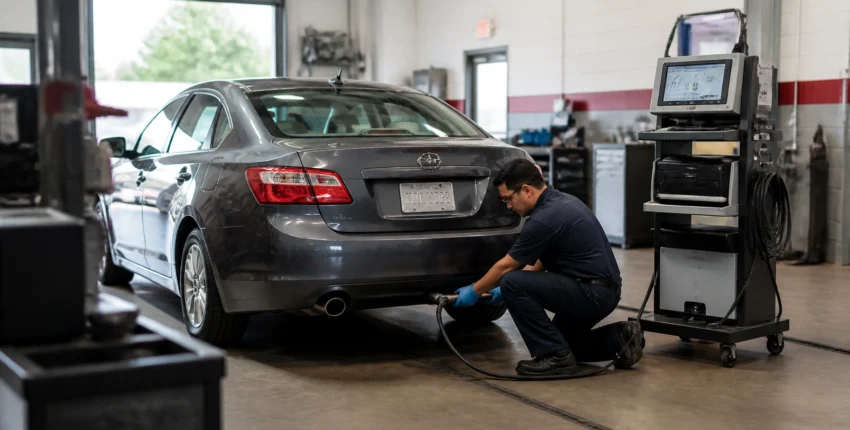
- The Emissions (Tailpipe) Test: On older vehicles (typically pre-2000), we use a probe in the exhaust to measure the actual pollutants being emitted while the car is running on a dynamometer (a treadmill for cars).
If you want a deeper look at the specifics, check out our step-by-step guide for Lomita residents.
Common Pitfalls to Avoid Near Lomita
Beyond the mechanical stuff, there are a few “lifestyle” factors that can trip you up at a Certified SMOG station Lomita:
- The Gas Tank Level: Surprisingly, your EVAP monitor (which checks for gas vapor leaks) often won’t run if your tank is bone dry or completely topped off. Keep your fuel level between 1/4 and 3/4 of a tank for the best results.
- Recent “Clearances”: We see it often: someone clears a code in the parking lot and walks in. We can tell! The machine will show “Incomplete” monitors, and you’ll have to pay for a re-test later.
- Oil Quality: While not a direct fail in all cases, very old, dirty oil can lead to higher hydrocarbon readings. Fresh oil is always a good idea before a test. You might even want to look into choosing the right oil and filter before your appointment.
Bottom Line
A SMOG check doesn’t have to be a gamble. By ensuring your Check Engine Light is off, driving your car on the highway for 20 minutes before your appointment, and making sure you haven’t recently disconnected your battery, you’re already 90% of the way to a passing grade. The goal isn’t just to get a sticker: it’s to ensure your vehicle is running efficiently, saving you money on gas and protecting the air we all breathe throughout Lomita.
At Hillside Auto Clinic, we pride ourselves on being a transparent, helpful partner for your vehicle’s health. We use exclusively OEM factory parts for any necessary repairs and back our work with a 12-month/12,000-mile warranty, so you know the job is done right the first time. Plus, if repairs are needed to get you passing, we offer flexible financing through Snap Finance with no credit needed.
Don’t let that DMV notice stress you out any longer. We’re here to make the process quick, easy, and affordable.
Ready to get your certification? Visit Hillside Auto Clinic today for a $40 SMOG check. Our experienced team is ready to get you back on the road safely and legally. Give us a call or book your appointment online now!