If you’ve been dreading that first heatwave of the season, you’re not alone. We’ve all had that moment of panic: you’re sitting in Lomita traffic, the sun is beating down on your dashboard, and you realize the “cool” air coming out of your vents feels more like a hairdryer on low heat.
The truth is, many of us unknowingly set ourselves up for a miserable summer by trying to take shortcuts with our car’s air conditioning. It’s one of the most complex systems in your vehicle, yet it’s often the one drivers try to “hack” with a quick fix from a hardware store. At Hillside Auto Clinic, we see the aftermath of these “quick fixes” every June, and usually, they end up costing much more than a standard service would have in April.
Let’s dive into the seven most common mistakes you might be making with your car AC repair and how you can get things right before the California sun starts cooking your upholstery.
1. The “Can-of-Freon” Trap
We’ve all seen those DIY recharge kits at the local auto parts store. They promise a frosty cabin in five minutes for twenty bucks. It sounds like a dream, but in reality, it’s often the beginning of a nightmare for your compressor. Most of these kits come with a generic gauge that only measures low-side pressure, which doesn’t give you the full picture of your system’s health.
The Fix:
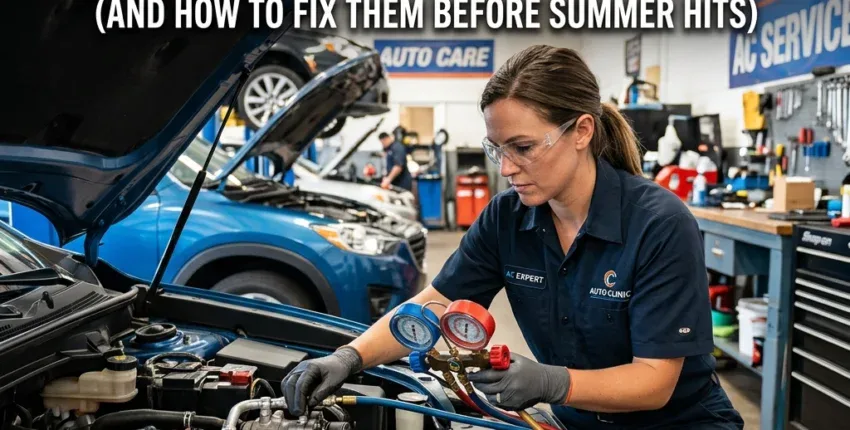
The big picture here is precision. Modern AC systems are designed to hold a very specific amount of refrigerant: often measured down to the ounce. If you overcharge the system (which is incredibly easy to do with a DIY kit), you risk “slugging” the compressor, which happens when liquid refrigerant enters the compressor and destroys its internal valves. Instead of a $150 service, you’re now looking at a $1,200 compressor replacement. At Hillside Auto Clinic, we use specialized recovery and recharging machines that vacuum the system to remove moisture and then inject the exact factory-specified amount of refrigerant.
2. Ignoring the Cabin Air Filter
It’s the simplest part of your AC system, yet it’s the most neglected. If you notice a “musty” smell when you turn on the air, or if the airflow feels weaker than it used to, you’re likely dealing with a clogged cabin air filter. Your AC system has to work twice as hard to pull air through a filter filled with dust, pollen, and Lomita road debris.
The Fix:
Check your cabin filter every 12,000 miles or at least once a year. It’s an inexpensive part that protects your health and your blower motor. A clean filter ensures maximum airflow, which means your cabin cools down faster and your AC components don’t have to run at maximum capacity for long periods. If you aren’t sure where yours is located, we can swap it out for you during your next factory scheduled maintenance.

3. Treating the Symptom, Not the Disease
Low refrigerant is a symptom, not the problem itself. Your car’s AC is a “closed” system, meaning it shouldn’t lose refrigerant unless there is a leak. If you find yourself needing a “recharge” every summer, you have a leak. Continuing to add gas without fixing the leak is like trying to fill a bucket with a hole in the bottom.
The Fix:
You need a professional leak detection test. We use UV dyes and electronic “sniffers” to find the exact point of failure: whether it’s a dry O-ring, a pinhole in the condenser, or a failing evaporator. Fixing the leak once is much cheaper (and better for the environment) than buying a can of refrigerant every three months.
4. Mixing Incompatible Refrigerants and Oils
Not all AC systems are created equal. Older cars use R-134a, while most vehicles built after 2015-2017 use R-1234yf. These refrigerants: and the oils used to lubricate the compressor: are not interchangeable. Mixing them can cause the oil to “sludge” up, essentially turning your AC system’s blood into molasses.
The Big Picture:
Using the wrong fluid is one of those mistakes that often leads to a “black death” scenario, where the entire system is contaminated by metallic shavings and burnt oil. Always check your under-hood sticker for the correct refrigerant type. If you’re unsure, let a pro handle it. We stock all the necessary OEM-grade fluids to ensure your system stays clean and lubricated.
5. Cranking the AC the Second You Start the Car
We get it: it’s 95 degrees out, and you want relief now. But hitting the “Max AC” button the moment you turn the key puts an enormous amount of stress on your engine and the AC compressor. It also doesn’t actually cool the car faster because the air inside the cabin is currently hotter than the air outside.
The Fix:
Try this neighborly advice: Roll your windows down for the first minute of driving to let the hot air escape naturally. Set the AC to a medium fan speed and turn off “recirculate” for the first few blocks. Once the air coming out of the vents feels cool, roll up the windows and hit the recirculate button. This helps the system reach its target temperature much more efficiently without overworking the compressor.

6. Opting for “Budget” Aftermarket Components
When a major component like a condenser or compressor fails, the price tag for a new one can be a bit of a shock. It’s tempting to hop online and buy the cheapest aftermarket part you can find. However, AC systems are incredibly sensitive to “heat exchange” efficiency. A cheap condenser might have fewer cooling fins or thinner tubes, meaning your AC will struggle to keep up when you’re idling at a red light.
The Fix:
This is where the OEM vs. Aftermarket debate really matters. At Hillside Auto Clinic, we prioritize OEM (Original Equipment Manufacturer) parts because they are guaranteed to fit and perform exactly like the part that came on your car. Plus, we stand behind our work with a 12-month/12,000-mile warranty, giving you the peace of mind that your “fix” is actually a long-term solution.
7. Waiting Until the System Fails Completely
Most drivers don’t think about their AC until it stops blowing cold. By that point, a small issue: like a failing pressure switch or a dirty condenser: might have already caused permanent damage to the compressor.
The Fix:
Think of AC service like an oil change. A quick inspection once a year can catch debris buildup on your condenser (the radiator-like part at the front of your car) or identify a belt that’s about to snap. Regular engine diagnostics and system checks prevent the kind of catastrophic failures that ruin summer road trips.

The Bottom Line
Your car’s air conditioning isn’t just a luxury in Southern California; it’s a safety feature that keeps you alert and comfortable. Avoiding these seven mistakes boils down to one simple rule: Don’t guess, and don’t settle for “good enough.” Taking care of your AC with professional tools and high-quality parts today will save you from a sweaty, expensive disaster tomorrow.
If you’re worried about the cost of a major AC repair, don’t let that stop you from staying cool. We offer Snap Finance to help you break up those larger repairs into manageable payments. You can read more about how to manage unexpected car costs in our guide on how Snap Finance can help.
Stay Cool with Hillside Auto Clinic
Don’t wait for the first triple-digit day to find out your AC is on its last legs. Whether you need a simple cabin filter swap or a complex system leak repair, your neighbors at Hillside Auto Clinic in Lomita are here to help. We pride ourselves on being the trustworthy alternative to the dealership, offering expert service with a personal touch.
Ready to beat the heat? Contact us today to schedule your AC performance check, or stop by our Lomita shop and let’s make sure you’re ready for summer!